
One account for every ranch, owner, state and country
Software for vineyard management companies: separate records for each client owner, one crew list for every ranch, and each site kept to the rules of its own county, state and country.
A vineyard management company doesn't farm one vineyard. It farms many, for many owners.
One owner has two parcels. Another has one. A third has a ranch in a different county, or a different state. Some years you take on ground in another country. The crew is the same crew. The work is the same work. But every owner wants their own records, and every place has its own rules.
Most farm software is built for one farm with one owner. So the management company ends up with one login per client, or one big farm where everyone's blocks are mixed together, and a spreadsheet on the side to work out whose is whose.
Carbonleap is built the other way round. Here's how it fits together.
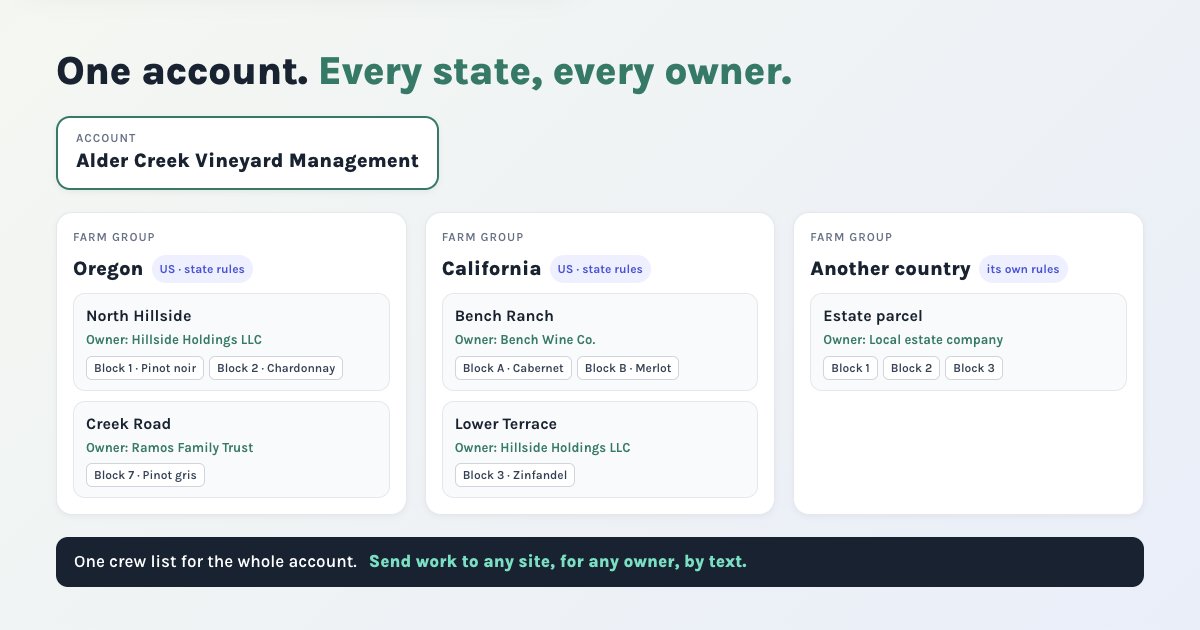
Your account, then farm groups
One account is your company.
Inside it you make farm groups. Most companies make one per state, or one per country. You can also split by region or by team, if that's how you run.
Switch between farm groups at the top of the screen. Each one has its own map, its own blocks and its own records. The Oregon blocks don't get mixed up with the California blocks, and neither gets mixed up with the ground abroad.
Blocks, then sites
Inside each farm group you upload your blocks, with their boundaries on the map.
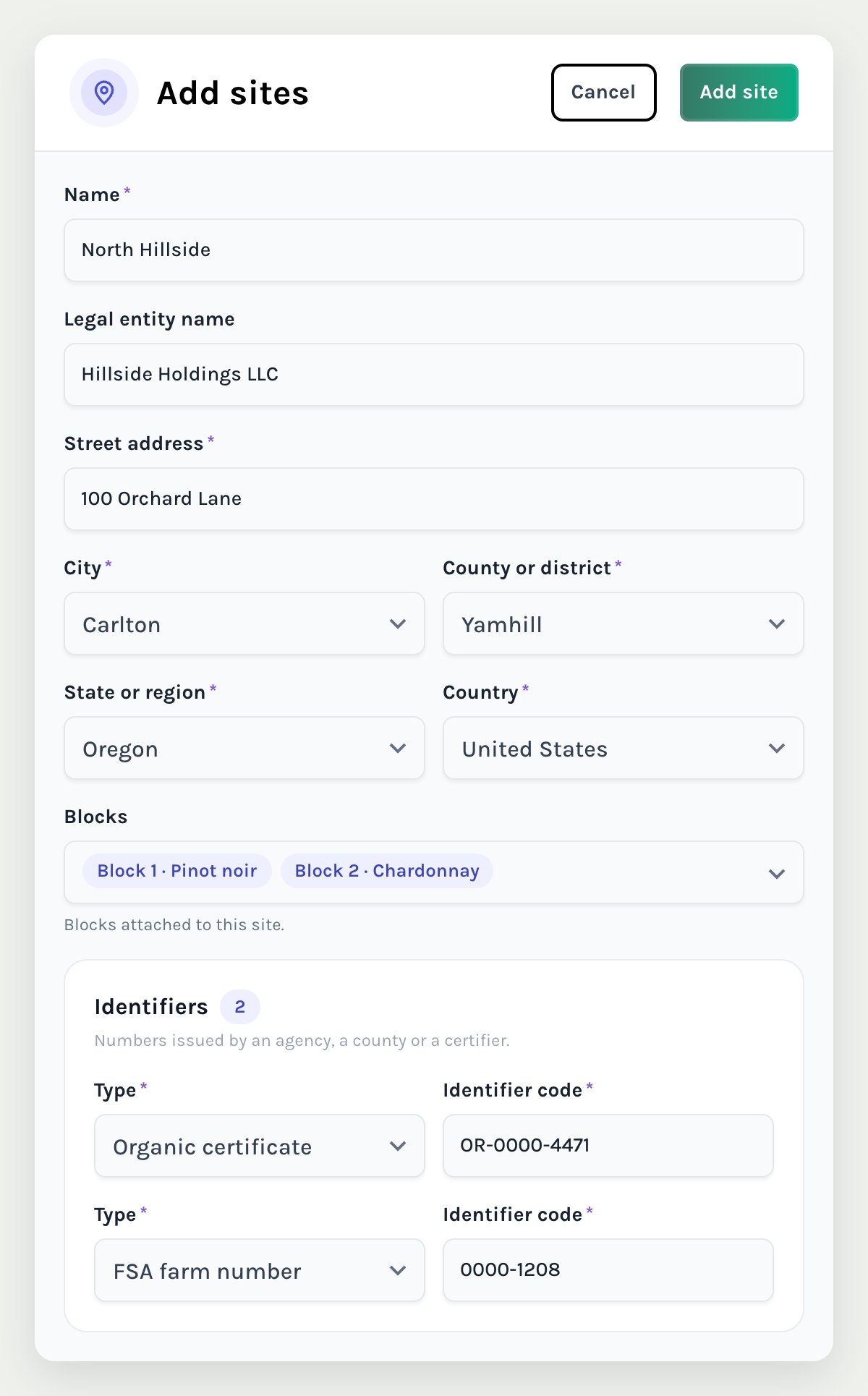
Then you put the blocks into sites. A site is one parcel of land with one owner. It keeps:
- its own name, the one your crew uses
- the legal owner: the person, family trust or company that owns the ground
- the address, city, county or district, state and country
- the blocks on it
- its own identifiers: the numbers an agency, a county or a certifier gave that parcel, with who issued each one, when, and when it runs out
The identifiers you can keep on a site include the FSA farm number, the operator ID, the restricted materials permit, the site ID, the business registry number, and organic, LIVE, Salmon-Safe and SIP certificates.
So when an inspector asks about the organic block on the Creek Road parcel, the certificate number and its expiry are on that site, not in a binder at the office.
Separate records for each owner
Everything you record is recorded on a block: sprays, scouting notes, tasks, photos, forms. Each block sits in one site, and each site has one owner.
That means each owner's records stay separate without you doing anything extra. You never have to sort a shared spreadsheet by hand to work out which sprays went on whose ground.
If one owner has parcels in two states, that's fine too. Each parcel is its own site, in its own farm group, under the rules of its own state.
One crew, every ranch
Your crew doesn't belong to one owner, and in Carbonleap it doesn't have to.
There's one contact list for the whole account. Each person can get their work by text, WhatsApp or email, whichever they prefer.
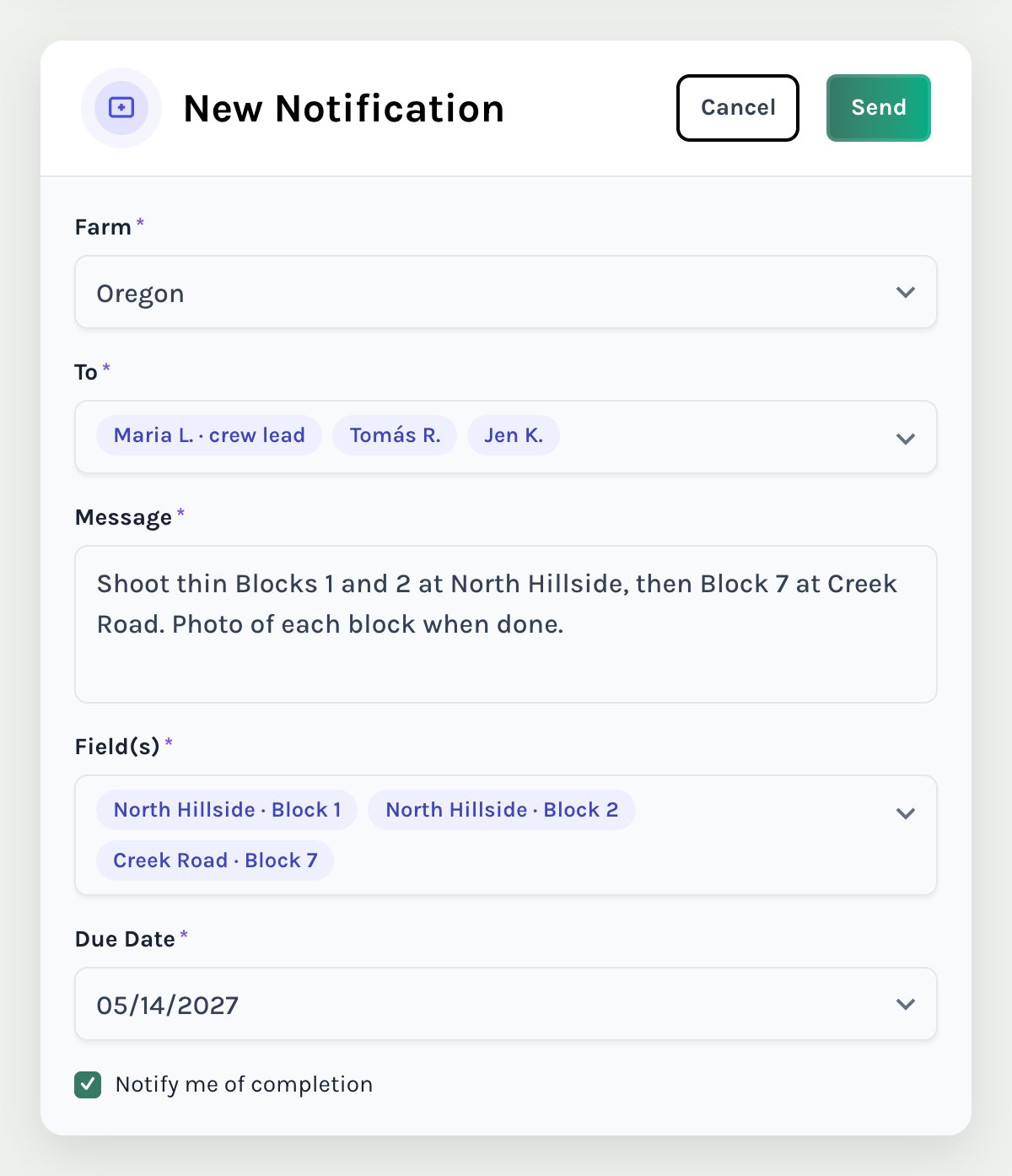
To send work, you pick the farm group, the people, and the blocks. The blocks can be on different sites, owned by different owners. Add the message and a due date, and attach a work order if the job needs one. Tick Notify me of completion and you'll hear when it's done.
The crew answers from their phone. Their reply comes back on the same job, tied to the same blocks, so the record lands on the right owner's sites.
Every place keeps its own rules
The rules for farming change at every border. A state sets its own pesticide rules. A county wants its own permit numbers. A buyer or a certifier wants its own certificate.
Carbonleap keeps those rules with the ground they belong to:
- Each site carries its own county, state and country, and the permit and certificate numbers issued for it.
- Each block carries its certifications and the state whose rules apply, so a spray plan is checked against the right rules. (See A spray done right for how that works on spray day.)
- Your company is set up once, as the operator: the legal name and the numbers named on every permit and filing.
Different places, different numbers, different rules. One place to keep them.
What you need to start
- Your block boundaries.
- A list of your sites and who owns each one.
- Your crew's phone numbers.
Make a farm group for each state or country you farm in, and you're running.
Alder Creek Vineyard Management, its sites, owners, blocks, crew and numbers are an example. The screens and the steps are real.
Talk to us: Book a walkthrough for your company