
A spray done right, from the label to the record
The eight things every spray needs, from the ground and the label to the crew and the record, and how Carbonleap keeps each one without the paperwork.
A good spray is not hard to describe. The right product, at the right rate, on the right blocks, at the right time. Done by someone allowed to do it, wearing the right gear. Written down so you can prove it.
Doing it every time is the hard part. The facts you need sit in different places. The acres are on a map. The rules are on the label. The licences are in a file drawer. The plan is in your head or on a whiteboard. The record is a form somebody fills in at the end of a long day.
Most mistakes don't come from not knowing the fundamentals. They come from one of these facts being out of date, or in the wrong place, when the tank gets mixed.
Carbonleap keeps all of them in one place and carries each one into the next step. Here are the eight fundamentals of a spray, and what Carbonleap does with each.
1. Know your ground
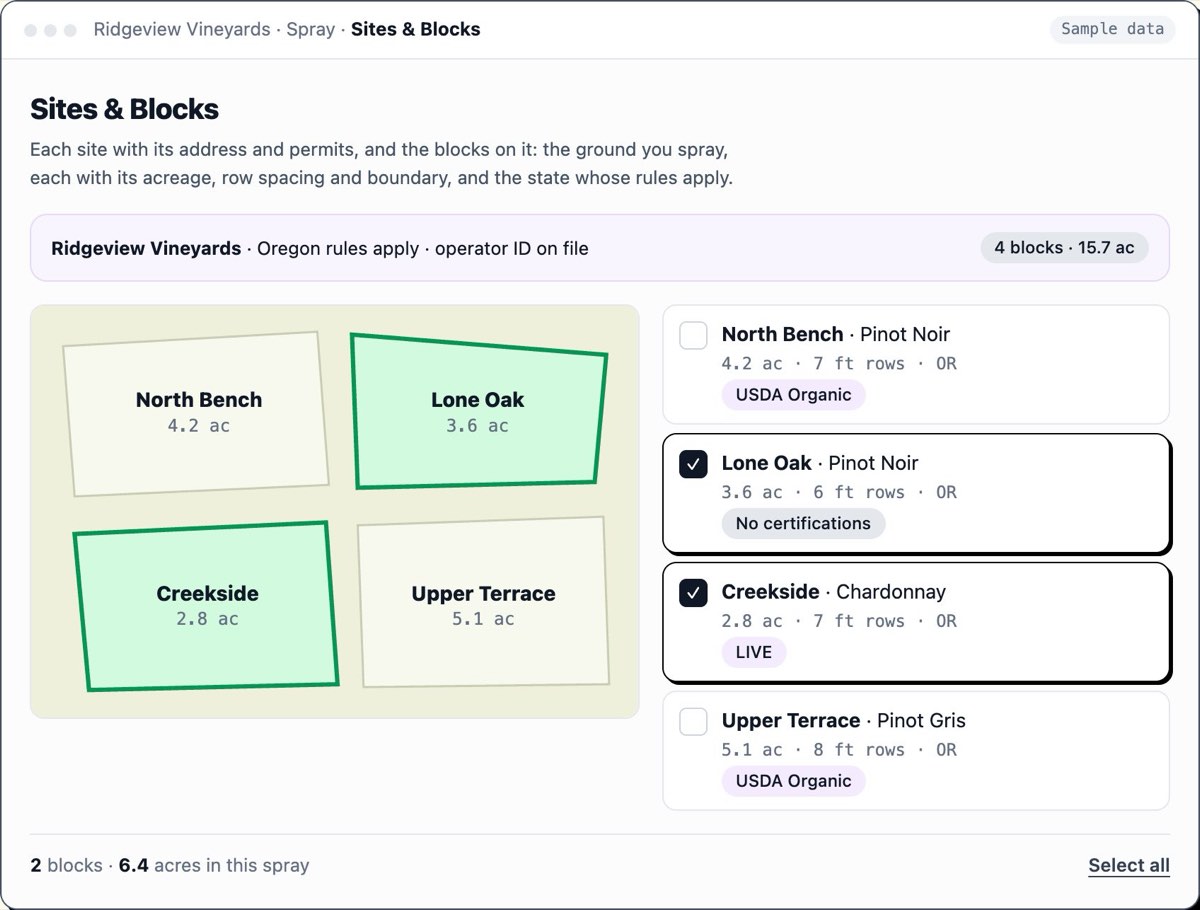
The fundamental. Every rate on a label is per acre, so you need the true acreage of each block. You need the row spacing, because it sets how you drive and how much you put down. You need to know which blocks are certified organic, LIVE or anything else, because that limits what you can spray there. And you need to know which state's rules apply.
In Carbonleap. Your sites and blocks come straight from your Carbonleap map. Each site keeps its address, its permits and your operator ID. Each block keeps its acreage, row spacing, boundary, certifications and the state whose rules apply.
You pick the blocks for this spray on the map. Say two blocks, 6.4 acres. Every number after this is worked out from those acres.
2. Read the label
The fundamental. The label is the law. Before a product goes in the tank, you need to know:
- what it is, and its EPA number
- whether it's restricted-use, which decides the licence you need
- the re-entry interval: how many hours before anyone walks back in
- the pre-harvest interval: how many days before you can pick
- the protective gear: for example chemical-resistant gloves, protective eyewear, a respirator
- the restrictions: for example not above 90 °F, wind under 10 mph
- the season limits: for example 3 applications a season, and the days you must wait between them
- whether it's allowed on organic ground
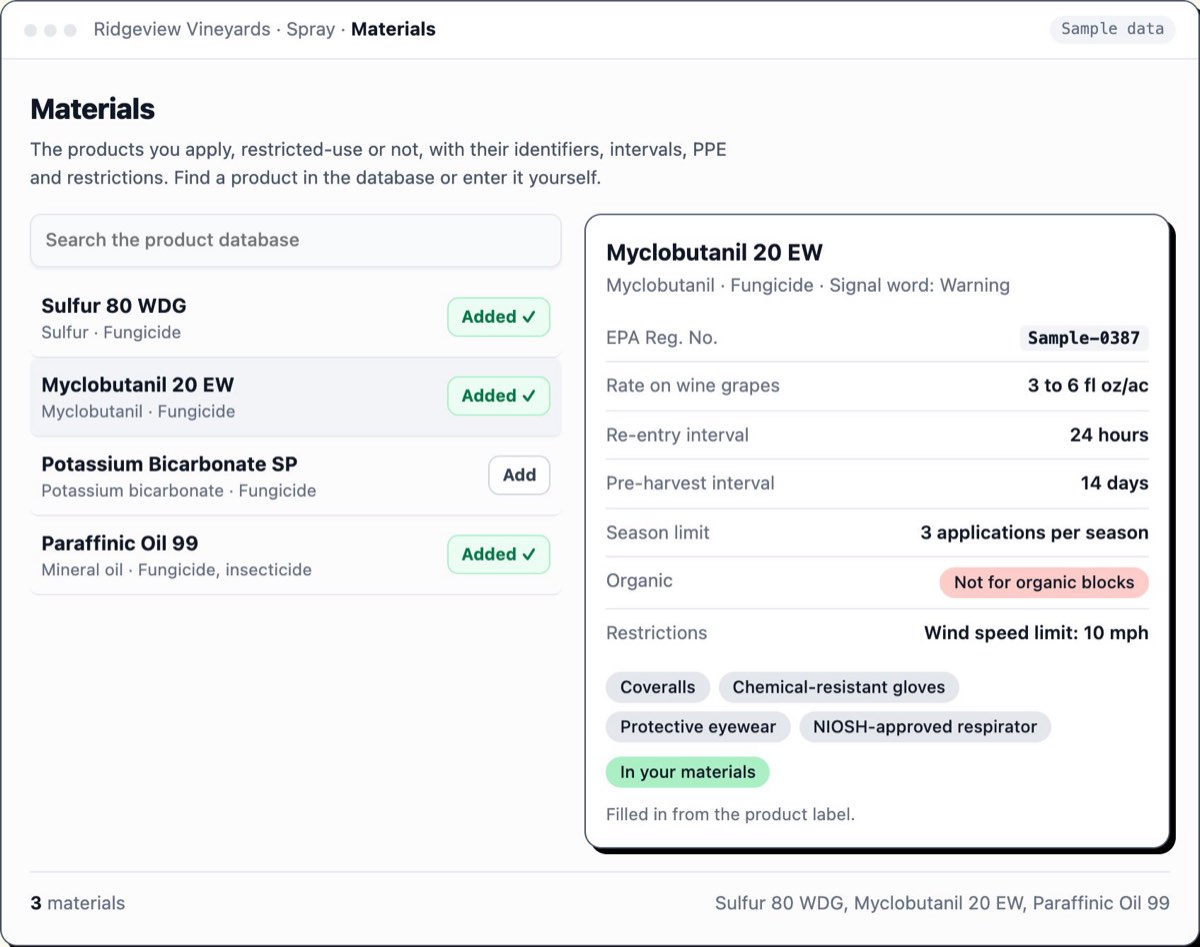
In Carbonleap. Search the product database by name or EPA number, or enter a product yourself. The label comes with it: identifiers, intervals, gear, restrictions and season limits, filled in. Organic listing and season limits are flagged.
You read the label once, when you add the product. After that, Carbonleap carries it into every spray that uses it.
3. Know who is allowed to spray
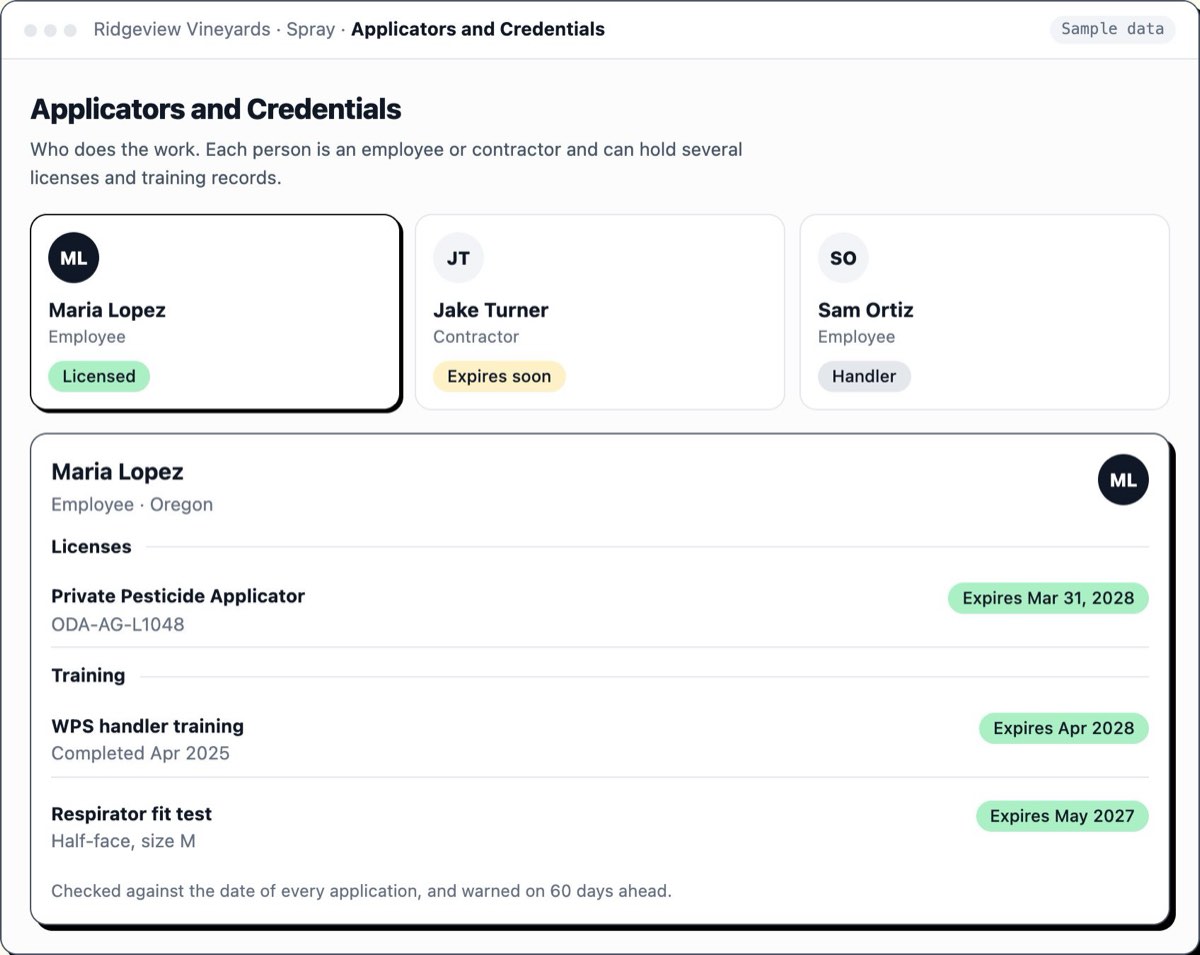
The fundamental. The person mixing, loading and applying needs the right licence and current training. That means an applicator licence for restricted-use products, and WPS handler training. If the label calls for a respirator, they need a fit test too. Licences expire. An expired licence on spray day is a problem, even if nobody notices until the audit.
In Carbonleap. Each person is on file as an employee or a contractor, with their licences and training: applicator certificate, WPS handler and worker training, respirator fit test. Expiry dates are checked against the date of every spray.
If a licence runs out in 5 days, you see it before you send the job. If someone has no licence on file, Carbonleap says so plainly: they can mix, load and apply only under a licensed supervisor.
4. Build the tank mix
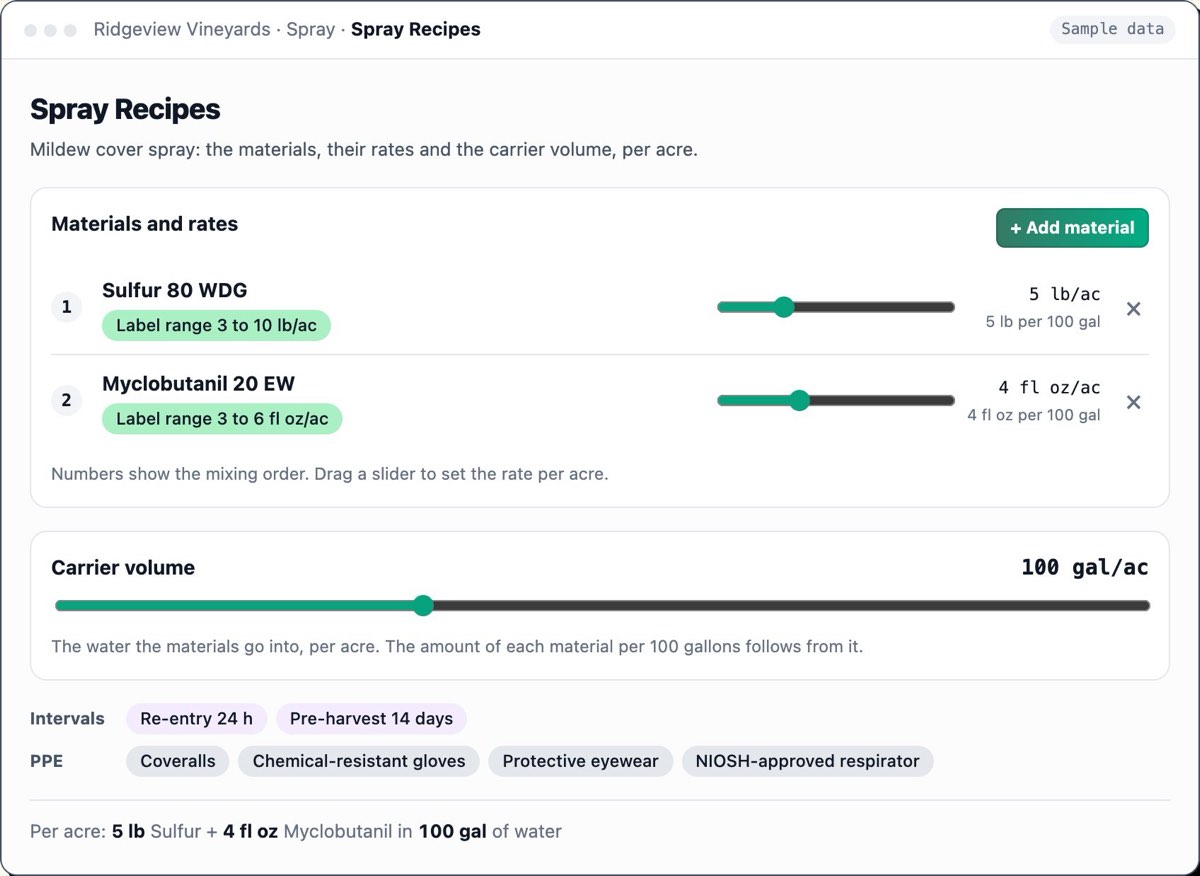
The fundamental. A tank mix is the materials, the rate per acre for each, the carrier volume, and the order they go in. Get the order wrong and the mix can clump or separate. Go over the label's top rate and you're breaking the law. When you mix products, the strictest interval and the heaviest gear win.
In Carbonleap. A spray recipe is that tank mix, saved once. For example, a mildew cover spray. Add materials from your list and set a rate per acre for each, plus the carrier volume. Every rate is checked against the label as you set it. The mixing order is numbered. Re-entry, pre-harvest and gear are rolled up from all the materials, so the strictest one shows.
5. Plan the season, block by block
The fundamental. One spray is never on its own. Before this one, you need to know:
- what's already gone on each block this season
- how many days since the last spray, against the label's retreatment interval
- how many applications of this product are left under its season limit
- when you'll be able to harvest, given the pre-harvest interval
- whether the disease pressure says you should spray at all
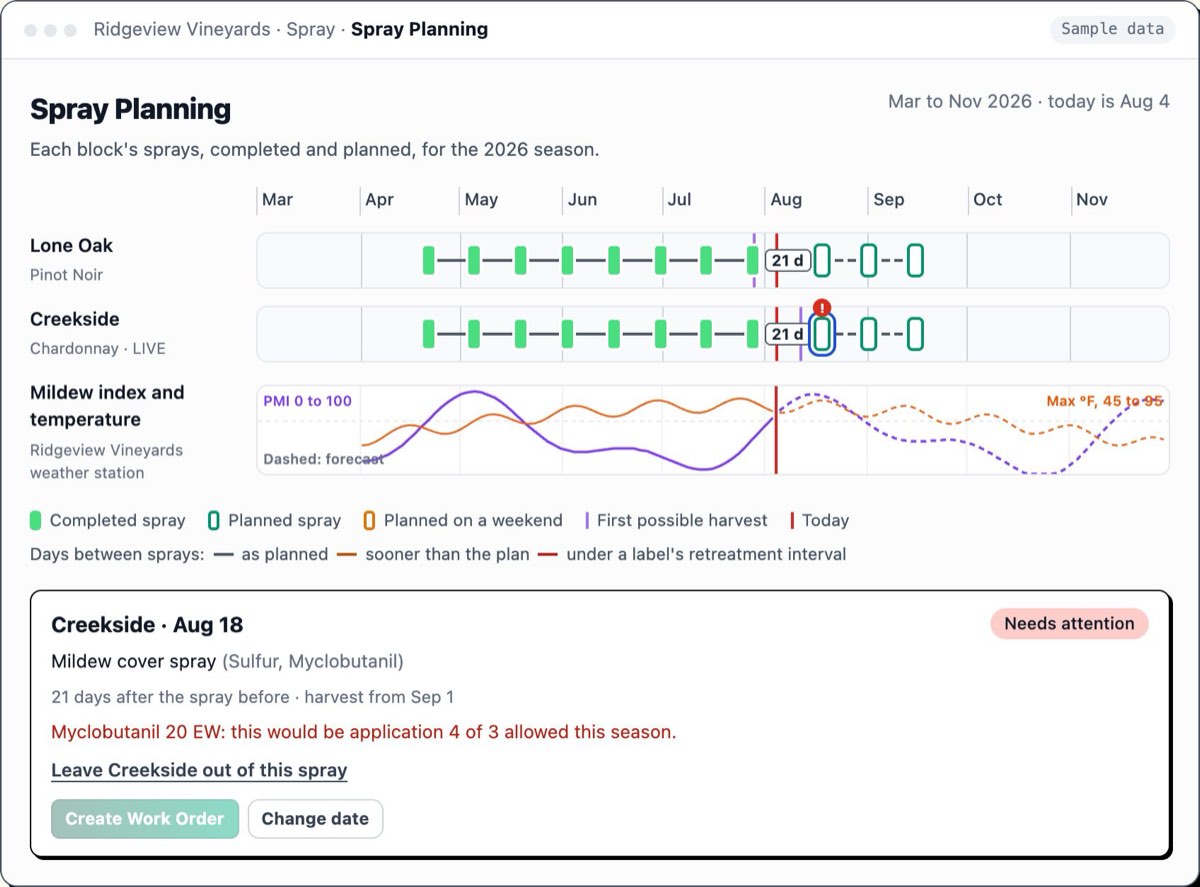
In Carbonleap. Spray Planning shows each block's completed and planned sprays on one season calendar. You see the days between sprays, the first possible harvest, and the powdery mildew index with the temperature alongside.
Problems are flagged before the tank is mixed. Too soon after the last spray? Over the season limit? Not allowed on that block's certification? Carbonleap shows it on the calendar, with a fix you can make in one click. For example, leave the flagged block out of this spray and treat it later.
6. Send the crew everything they need
The fundamental. The crew needs more than "spray Block 4". They need the recipe in mixing order, how much goes in each tank, how many loads, the gear, and the blocks on a map. And you have to post a sign at the site: which blocks, when, what was sprayed, and when it's safe to go back in.
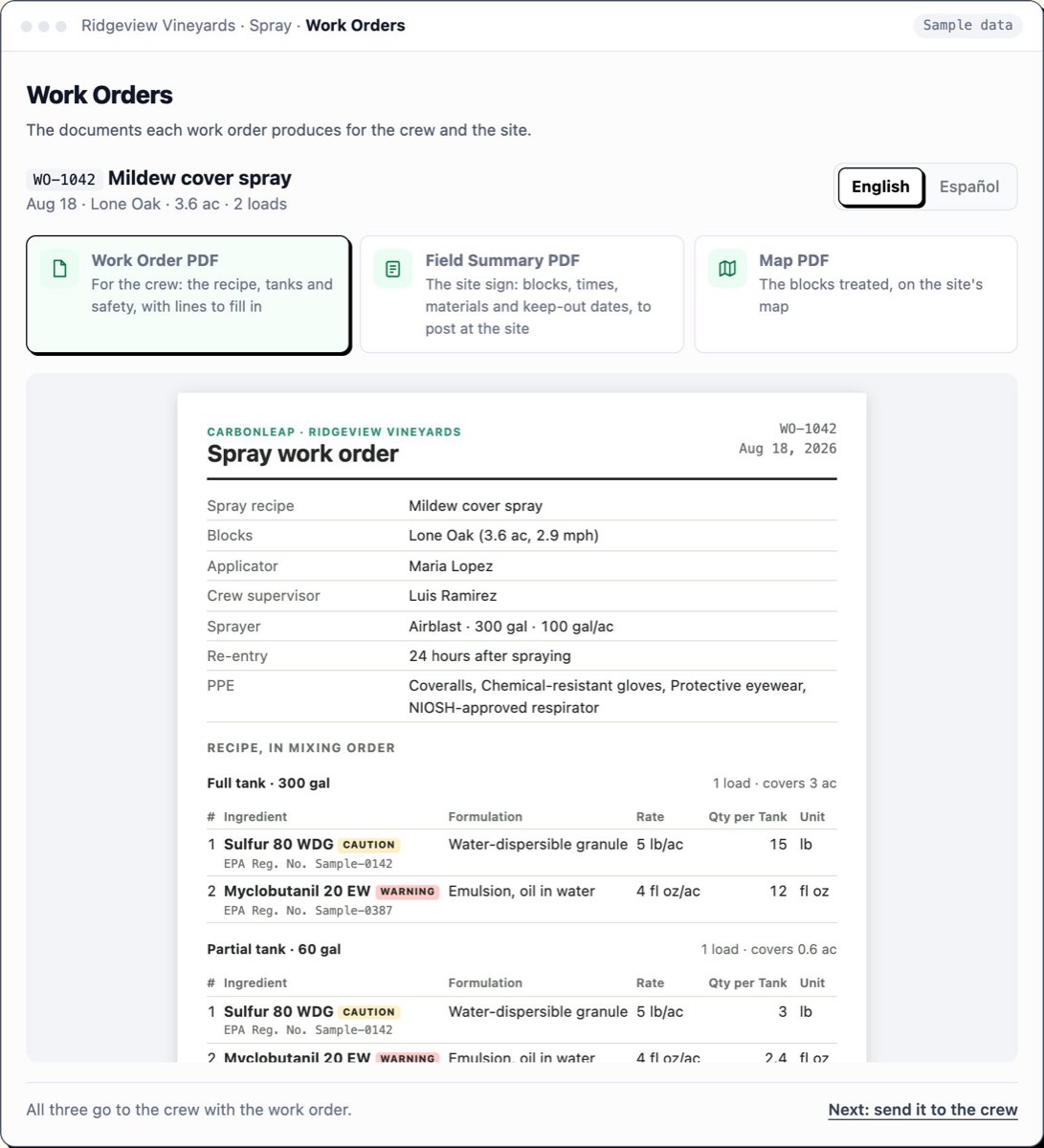
In Carbonleap. One click turns the recipe and the planned blocks into three documents:
- The work order, for the crew: the recipe in mixing order, the amount per tank for full and partial loads, the number of loads per block, the gear, and lines to fill in. Tractor speed is set for each block's row spacing.
- The field summary, the sign for the site: blocks, times, materials, the keep-out date from the re-entry interval, and the no-harvest date from the pre-harvest interval.
- The map of the blocks to treat.
All three come in English or Spanish. The work order also tells the crew what to pull from storage.
7. Watch the job, not the phone
The fundamental. Conditions change during a spray. Wind picks up. A nozzle clogs. Somebody has to know how far the crew has got, and be reachable.
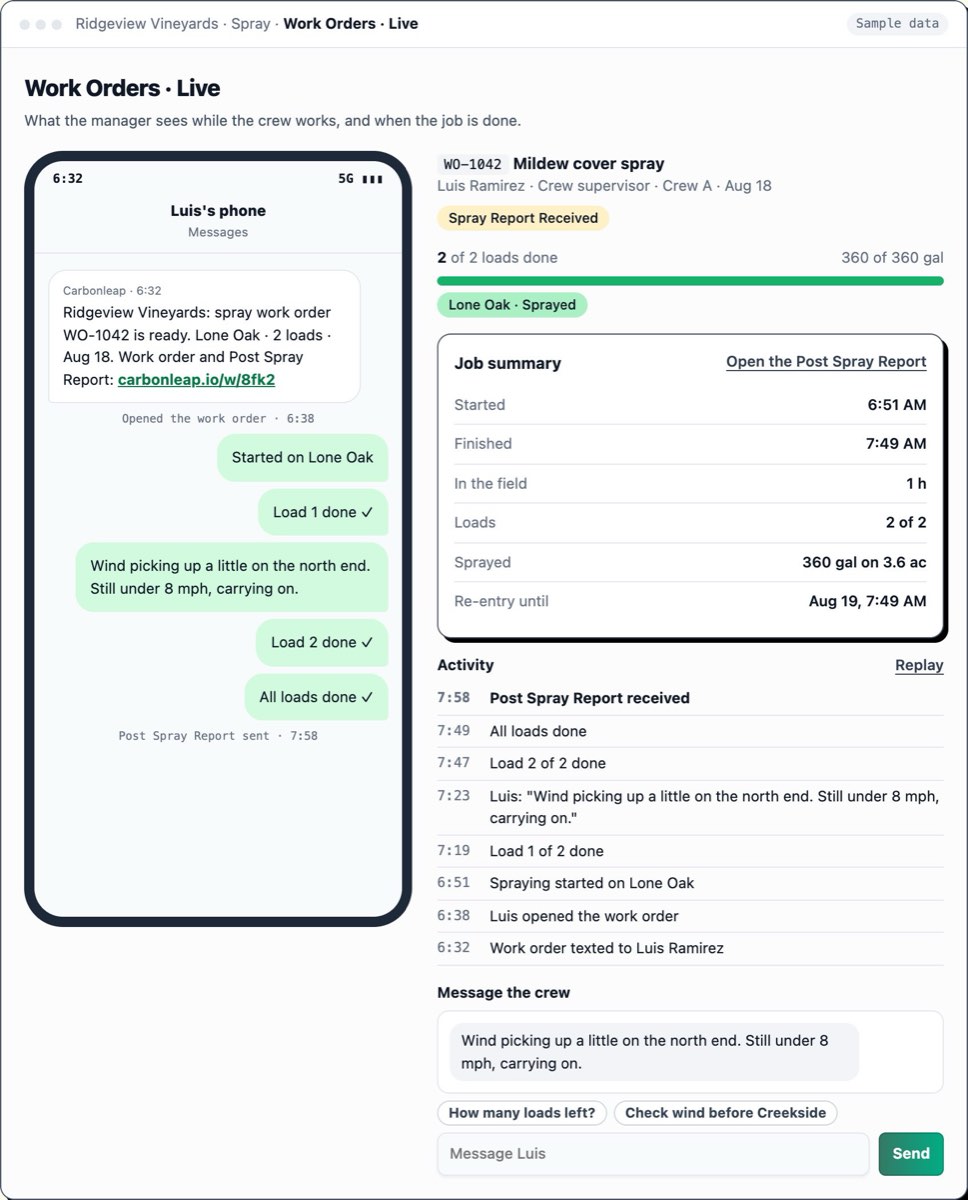
In Carbonleap. The crew supervisor gets the work order by text. There's no app to install. As loads are finished, you see progress by load and by block, the times and the gallons, as it happens. You can message the crew from the work order: "Wind picking up a little on the north end. Still under 8 mph, carrying on." When the last load is done, you get a job summary.
8. Record what actually went on
The fundamental. The spray record is what the auditor, the county and your buyers will ask for. It needs the date and times, the blocks and acres treated, who applied it, the equipment, the materials and amounts, and the total volume sprayed. It has to show what actually happened, not what was planned.
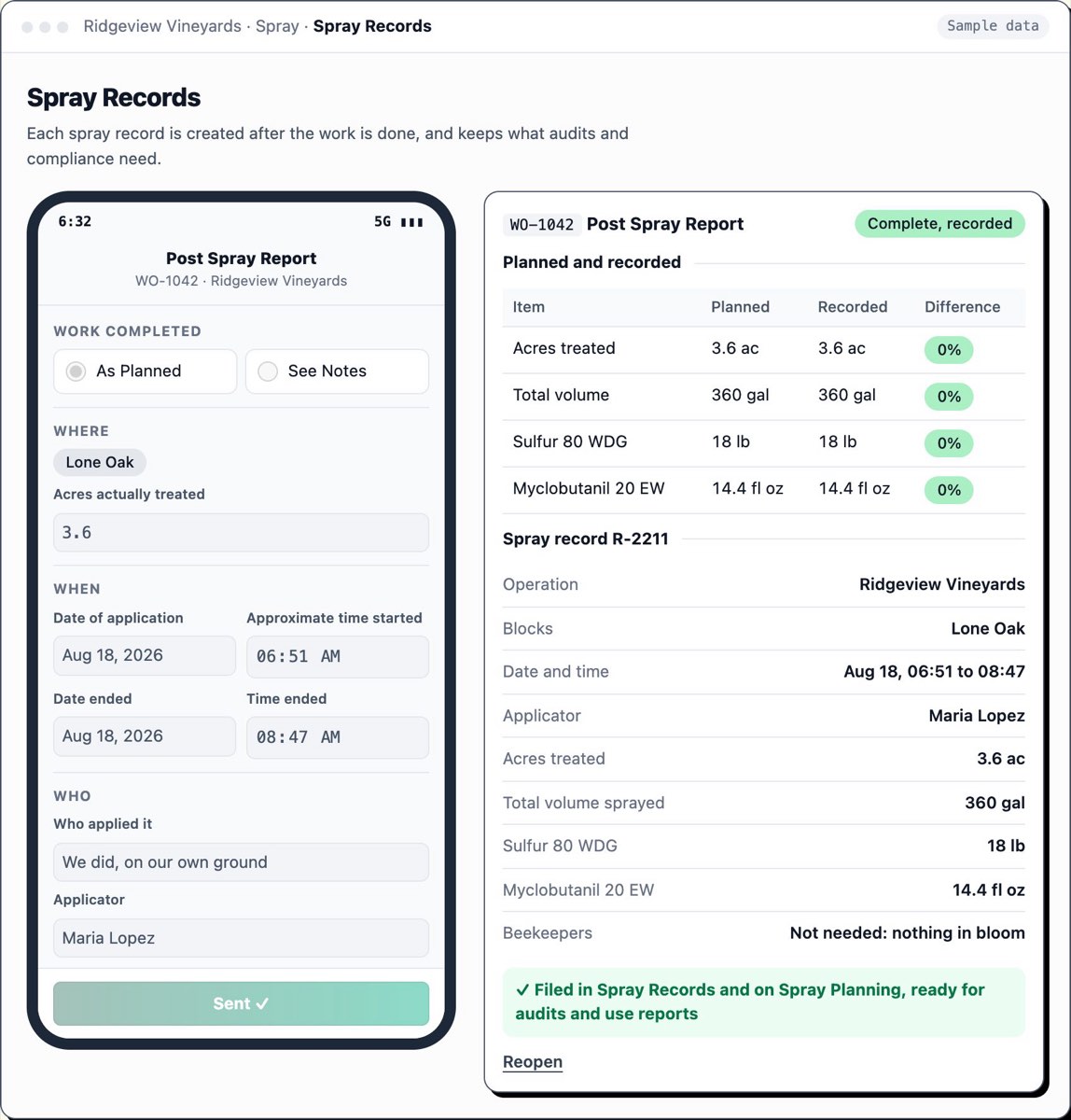
In Carbonleap. The crew fills in the Post Spray Report from the same link they got the job on: the date, start and end times, who applied it, the equipment, the acres actually treated, the total gallons, and notes.
Carbonleap lays the plan next to what was recorded, material by material. If any figure is more than 10 per cent off the plan, it's flagged so you can look before the record is made. It isn't blocked: what went on the ground is the fact.
One click files the spray record. It sits in Spray Records and on the season plan, ready for audits and use reports.
What changes
The fundamentals don't change. You still read the label, check the licence, set the rate, respect the intervals, post the sign and keep the record.
What changes is that you do each one once. The acres come from the map. The label comes with the product. The licences are checked against the date. The rates are checked against the label. The intervals become dates on the sign. The plan becomes the work order, and the work order becomes the record.
Nothing is typed twice, and nothing is copied from one sheet to another, where the mistakes happen.
The products, rates, limits and blocks above are an example. Always follow the label of the product you use. The steps and checks are real.
See it on a block: The spray window, step by step